Career Advice
How to Build a Standout Automotive Resume in 2026
Your resume is your first RO — if the service manager can't diagnose what you bring to the shop in 30 seconds, you're getting filed in the circular bin.
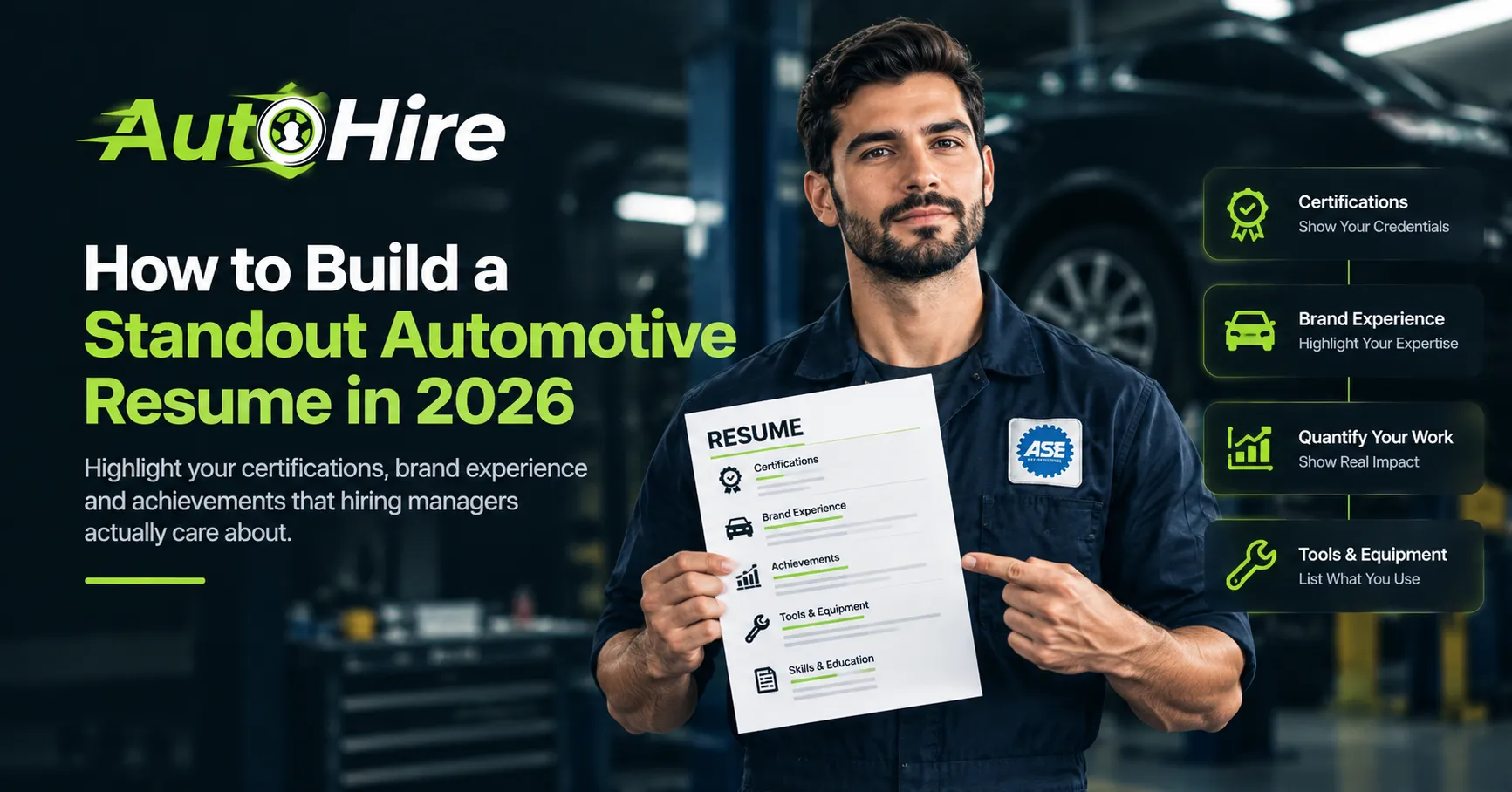
I've reviewed thousands of automotive resumes over the years — as a hiring manager, as a consultant, and frankly as a guy who other people in the business just hand resumes to at NADA and say "what do you think?" And I can tell you with absolute confidence that 80% of them are terrible. Not because the people behind them aren't talented. They are. The resumes are terrible because they were built using templates and advice designed for office jobs, and nobody ever told these folks what an automotive hiring manager actually wants to see.
So let me tell you what we actually want to see.
Certifications Go at the Top — Period
I don't care what the resume advice blogs say about leading with a "professional summary" or an "objective statement." In automotive, your certifications are the first thing a service manager looks at. Full stop. If I'm hiring a line tech and I have forty resumes on my desk, I'm scanning the top third of page one for ASE credentials. If I don't see them within five seconds, that resume goes to the bottom of the pile.
List every active ASE certification you hold, organized by series. A1 through A8 for general automotive. L1 and L2 if you have them — and if you have L1 (Advanced Engine Performance Specialist), put it first because that's a golden ticket at most dealerships. T-series for medium/heavy truck. If you hold Master Technician status, lead with that designation in bold. It should be the most prominent thing on your resume after your name and phone number.
Here's a detail most people miss: include your certification expiration dates or at least indicate "current" status. I've called candidates about expired certs more times than I can count. If yours are current, make that obvious. If you're actively testing for additional certifications, note that too — something like "ASE A6 scheduled October 2026" shows initiative and tells me you're investing in yourself.
And don't forget manufacturer-specific certifications. Toyota T-TEN levels, Honda PACT certification, BMW STEP qualification levels, Ford ASSET completion — these matter enormously when you're applying to a franchise dealership. A Toyota dealer looking at a candidate with T4 certification versus one with no factory training? That's not even a close call, assuming the rest of the resume is comparable. The factory-trained tech gets the interview every time.
Brand Experience Is Not Optional Information
Generic resumes list employers and job duties. Automotive resumes need to list brands. This sounds obvious, but you would be stunned how many technician resumes I see that say things like "Performed maintenance and repair on various vehicles" without ever specifying what vehicles.
Various vehicles. That tells me nothing. Were you working on Kias or Koenigseggs? Domestic three-brand or European luxury? New vehicles under warranty or fifteen-year-old trade-ins from the buy-here-pay-here lot?
Every service department has a brand identity. Even independent shops tend to specialize — the guy on the corner might be known as the BMW shop or the diesel shop or the Japanese import specialist. When a hiring manager reads your resume, they're mentally mapping your experience against their service lane. If you spent six years at a Chevrolet dealer, they know you've seen LT and LS engine platforms, they know you've used GM's GDS2 diagnostic tool, and they know you can navigate GM's warranty claim process. That's real, applicable information that a generic description completely obscures.
Create a dedicated section — I'd call it "Brand Experience" or "Manufacturer Experience" — and list every make you've worked on with meaningful depth. Not just oil changes. Real diagnostic and repair work. If you've completed factory training for specific manufacturers, pair that information with the brand listing. Something like:
- Toyota / Lexus — 6 years dealership experience, T-TEN Level 3 certified, Techstream diagnostic proficiency
- General Motors (Chevrolet, GMC, Buick) — 4 years dealership experience, GDS2 and Tech2 platforms, warranty claim processing
- Honda / Acura — 2 years independent shop, HDS diagnostic experience
That format gives a hiring manager everything they need in about ten seconds. Compare that to "10+ years of automotive experience" which gives them essentially nothing.
Numbers Make You Real — Vague Claims Make You Invisible
Here's something I learned early in my career: in a stack of resumes, the ones with numbers stand out. Not because hiring managers are spreadsheet jockeys — most service managers I know would rather rebuild a transmission than open Excel — but because numbers are concrete. They're verifiable. They separate the person who actually performed from the person who just showed up.
Let me show you the difference. Here's what I see on most resumes:
- "Performed vehicle diagnostics and repairs"
- "Maintained high customer satisfaction"
- "Worked efficiently in a fast-paced environment"
Here's what makes me pick up the phone:
- "Averaged 52 flag hours per week over 24 months on a 40-hour flat-rate schedule"
- "Maintained 96.3% fix-it-right rate across 2,400+ repair orders annually"
- "Consistently ranked top 3 in technician productivity among 14 techs in the service department"
- "Reduced comeback rate from 4.2% to 1.8% over 12-month period"
See the difference? The first set could describe anyone. The second set describes a specific, high-performing technician that I want in my shop immediately.
If you're in a flat-rate environment, your flag hours tell a story. If you're salaried, your RO count and efficiency metrics tell a story. If you're in parts, your fill rate and obsolescence numbers tell a story. If you're in service advising, your hours-per-RO and effective labor rate tell a story. Whatever your role, find the numbers that demonstrate your performance and put them on the page.
Don't have exact numbers? Estimate conservatively and be honest about it. "Approximately 10-12 vehicles diagnosed and repaired per day" is infinitely better than "performed vehicle repairs." And if you're early in your career and don't have impressive production numbers yet, focus on training metrics, certification achievement speed, or any measurable growth — "Completed ASE A1 through A4 within first 14 months of employment" shows drive and trajectory.
Your Tool Inventory Is a Qualification
In most skilled trades, your employer provides the tools. In automotive — especially in flat-rate shops — your personal tool collection is a direct reflection of your capability and your commitment to the career. A service manager who sees that you own a Snap-on ZEUS diagnostic scanner, a Picoscope, and a full set of manufacturer-specific specialty tools knows they're looking at someone who is serious about this profession and capable of handling complex work without waiting for a shared shop tool to become available.
Create a "Tools & Equipment" section on your resume. Include:
- Diagnostic scan tools — brand and model (Snap-on ZEUS, Autel MaxiSys Ultra, etc.)
- Specialty diagnostic equipment — oscilloscopes, smoke machines, fuel pressure testing kits
- Alignment and chassis equipment proficiency — Hunter, John Bean, Hofmann
- Manufacturer-specific tools — Toyota Techstream, Honda HDS, BMW ISTA
- General tool inventory value — if your box is worth $35,000+, that's worth mentioning. It tells the manager you're invested.
This section also signals something important in a flat-rate environment: you can work independently. You're not going to be borrowing tools from the guy in the next bay or waiting for the shared scan tool cart. You can pull a vehicle in and get to work. That translates directly to productivity, which translates directly to revenue for the shop and earnings for you.
Format: Clean, Scannable, No Fluff
A service manager reviewing resumes is usually doing it between customer interactions, warranty claim approvals, and dispatching work. They don't have twenty minutes to study your life story. They have maybe sixty to ninety seconds per resume on the first pass. Your format needs to respect that reality.
Here's the structure that works best, based on what I've seen actually get results:
- Header: Name, phone, email, city/state (no full street address needed in 2026)
- Certifications: ASE, manufacturer, any other relevant credentials
- Brand Experience: Manufacturers worked on, with context
- Professional Experience: Reverse chronological, with quantified achievements
- Tools & Equipment: Key diagnostic and specialty tools
- Education & Training: Vo-tech programs, community college, factory training courses
Things to leave off: objective statements (nobody reads them), hobbies (unless they're directly relevant — racing experience or restoration work could be worth mentioning), and references ("available upon request" is assumed and wastes a line).
Keep it to two pages maximum. If you have twenty years of experience, that might feel tight, but prioritize the last ten years and summarize earlier roles in one or two lines each. A hiring manager in automotive cares most about what you've done recently and what you can do tomorrow.
One more thing about format: PDF only. Never send a Word doc — formatting shifts between systems, and nothing looks worse than a resume where the columns don't line up because the recipient's computer substituted a different font. PDF preserves your layout exactly as you designed it.
The Overlooked Power of a Cover Note
I know, I know — "nobody reads cover letters." And for most industries, that's probably true. But in automotive, a short, targeted note can set you apart because so few candidates bother. I'm not talking about a full-page letter. Three to four sentences that explain why you're interested in that specific shop and what you'd bring. Something like:
"I've spent the last eight years in a high-volume Toyota service department averaging 48 flag hours weekly. I'm looking to move to a dealership with a stronger commitment to factory training and career advancement for its technicians — which is what drew me to your listing. I hold ASE Master Technician certification and Toyota T3, and I'm ready to contribute from day one."
That takes thirty seconds to read and immediately tells the hiring manager three critical things: you're experienced, you're qualified, and you chose their shop for a specific reason. Most candidates never give them that.
Let AutoHire Do the Heavy Lifting
If formatting resumes isn't your thing — and let's be honest, most technicians would rather pull an engine than fiddle with margins and bullet points — AutoHire's built-in profile and resume builder handles the structure automatically. You enter your certifications, brand experience, tool inventory, and work history once, and the platform generates a clean, professional PDF formatted exactly the way automotive hiring managers want to see it.
More importantly, that same information powers AutoHire's matching system, so employers searching for your exact skill set can find you without you having to endlessly scroll job boards and re-enter the same information on fifteen different application forms. Build the profile once, and let the right opportunities come to you.