Industry Trends
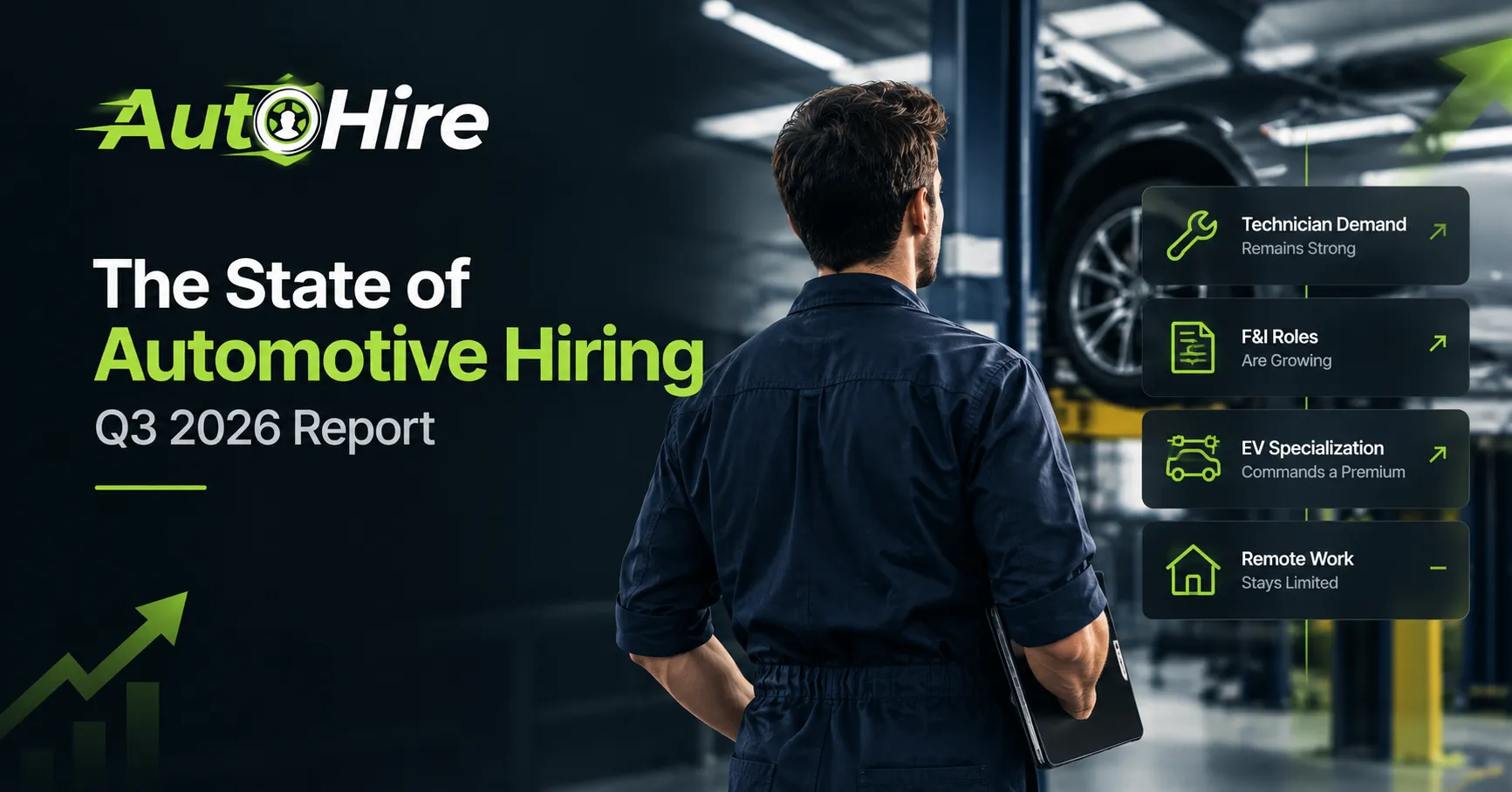
The State of Automotive Hiring: Q3 2026 Report
Techs are fielding multiple offers within 72 hours, EV-certified specialists are commanding premiums north of 20%, and F&I hiring is surging beyond the dealer level. Here's what the Q3 2026 data actually means for your next move.
Every quarter, I dig into the hiring data on AutoHire — thousands of job postings, candidate searches, application flows, and offer acceptances across the automotive industry. And every quarter, the story shifts just enough to keep things interesting. Q3 2026 is no exception. Some trends are accelerating, some are plateauing, and a few caught me genuinely off guard.
Let's get into it.
The Technician Shortage Isn't Getting Better. It Might Be Getting Worse.
I know, I know — we've been talking about the technician shortage for a decade. But the data this quarter paints a picture that should alarm anyone running a service department. Qualified technician candidates — meaning someone with at least three ASE certifications, a clean driving record, and a demonstrated work history — are receiving an average of 3.4 contact attempts from employers within 48 hours of activating their profile on AutoHire. That's not 3.4 views. That's 3.4 actual outreach messages or Sparks from hiring managers.
Think about what that means operationally. If you're a service director and you see a strong candidate hit the market on Monday, by Wednesday afternoon that person has already heard from three other stores. If you're still routing applications through your corporate HR portal and waiting for someone in a regional office to screen them, you've already lost.
The numbers back this up. Dealerships using automotive-specific recruiting tools — platforms like AutoHire that let hiring managers engage directly — are filling technician roles in an average of 18 days. Stores relying on generic boards like Indeed or ZipRecruiter? 34 days. That's nearly double, and in a service department running short-staffed, 16 extra days of an empty bay translates to real money. A productive tech generates somewhere between $12,000 and $18,000 in gross labor profit per month depending on the store. You do the math on half a month of lost production.
The root cause hasn't changed: fewer young people are entering the trades, vocational programs are underfunded, and the existing technician workforce is aging. The Bureau of Labor Statistics still projects the industry will need north of 70,000 new technicians annually through 2030 to keep up with demand and retirements. We're not producing anywhere close to that. UTI, the largest automotive trade school in the country, graduates roughly 10,000 students a year across all their campuses. Other programs fill some of the gap, but we're structurally short.
What's new this quarter is the speed of the market. Two years ago, a good tech might get a couple of calls in the first week. Now it's happening in the first two days. If you're hiring techs, your process needs to be measured in hours, not weeks.
F&I Hiring Is Expanding Well Beyond the Dealership
This one surprised me. F&I manager postings at traditional dealerships are up about 8% quarter-over-quarter — healthy growth, but nothing shocking given normal turnover rates. What caught my attention was the surge in F&I-adjacent roles outside the dealer world.
Product providers — the companies that underwrite and administer VSCs, GAP, tire-and-wheel, PPM, and the rest of the menu — are on a hiring spree. We're seeing double-digit growth in postings for regional sales managers, product trainers, compliance officers, and agency development roles. Companies like Protective, JM&A, EasyCare, and a wave of newer insurtechs are building out their teams aggressively.
Why? A few reasons. First, the aftermarket products business is booming. Per-vehicle-retailed (PVR) numbers across the industry have climbed steadily since 2023, and the providers supplying those products need people to sell, train, and support them. Second, digital retailing is creating new F&I workflow challenges that require dedicated staff to manage. Third — and this is the one nobody talks about enough — compliance is getting more complex. The FTC's enforcement actions, state-level regulatory changes, and the evolving CFPB landscape mean these companies need people who understand both the products and the legal framework.
If you're an experienced F&I manager thinking about your next chapter, don't limit your search to the dealer level. Provider-side roles often come with base salaries north of $90K, travel perks, and long-term equity or bonus structures that can outpace what you'd earn behind the desk — especially once you factor in the toll that 55-hour dealership weeks take on your quality of life.
EV Specialization: The Premium Is Real and Growing
We've been tracking the EV compensation gap since early 2025, and it continues to widen. This quarter, technicians and engineers with documented electric vehicle experience — whether that's factory training from an OEM like Tesla, Rivian, or one of the legacy manufacturers' EV programs, or independent certifications — are commanding 15-22% higher total compensation than their ICE-only peers at comparable experience levels.
Let me put some real numbers on that. A line technician with 5-7 years of experience and a solid set of ASE certs is pulling $65,000-$80,000 in most metro markets, depending on the brand and flat-rate structure. That same tech, with the addition of EV high-voltage safety certification and hands-on experience with battery diagnostics and electric drivetrains, is seeing offers in the $78,000-$95,000 range. At the master tech level, the spread gets even wider.
Here's the interesting part: the supply of EV-qualified technicians is not keeping up. OEMs are pouring money into training programs — Ford's EV certification pathway, GM's Ultium-specific curriculum, Stellantis's electrification training — but the pipeline is still thin. Most dealership techs haven't gone through formal EV training yet. The ones who have are effectively in a seller's market.
My advice to any technician reading this: get the training now, even if your current store doesn't require it. The investment will pay for itself multiple times over in earning power and job security over the next five years. This is not a fad. Every major OEM has committed billions to electrification. The work is coming whether your current store is ready or not.
Remote Work: Still Mostly a Non-Starter, With Some Notable Exceptions
I get asked about remote work in automotive at least once a week, and the answer hasn't changed much: the vast majority of automotive jobs require you to be physically present. You can't rotate tires from your home office. You can't deliver a car to a customer over Zoom. The parts counter doesn't run itself.
That said, there are pockets where hybrid and remote arrangements are becoming normalized. OEM-level engineering roles — particularly in software, ADAS calibration development, and connected vehicle services — increasingly offer hybrid schedules. Automotive tech companies (think CDK, Tekion, DealerSocket, and the growing ecosystem of SaaS vendors serving the industry) are mostly hybrid or remote-friendly. And on the provider side, regional roles in F&I product sales and training have always been road-warrior positions that now come with a remote home base instead of a mandatory office.
The data shows that about 12% of all active job postings on AutoHire this quarter mention some form of remote or hybrid flexibility. That's up from 9% a year ago, but it's still a fraction of what you'd see in sectors like tech or professional services. If remote work is a priority for you, focus your search on OEM corporate roles, vendor-side positions, and the growing number of automotive fintech and insurtech companies that are hiring aggressively.
A Note on Compensation Trends Across the Board
Broadly, compensation in automotive retail is up 4-6% year-over-year across most positions. That's ahead of general inflation but behind the gains we saw in 2023 and 2024 when the post-COVID labor crunch was at its peak. The biggest gains this quarter are concentrated in three areas: EV-specialized technicians (as noted above), experienced F&I managers with compliance backgrounds, and dealership-level IT and technology staff who can manage DMS migrations, cybersecurity compliance, and digital retailing platforms.
The softest compensation growth? Sales consultants. The variable pay model in sales means base pay hasn't moved much, and with inventory normalization reducing per-unit gross profits from the peak pandemic-era levels, total comp for the average sales consultant is essentially flat compared to Q3 2025. Top performers are still earning well, but the middle of the pack is feeling the squeeze.
What Should You Actually Do With This Information?
If you're a candidate: Your leverage is real, but it's not unlimited. The market favors qualified, certified professionals who present themselves well. Make sure your AutoHire profile is complete — that means current certifications, brand-specific experience, tools owned, and a clear indication of what you're looking for. Employers consistently tell us that incomplete profiles are the number-one reason they pass on otherwise-strong candidates. Also, respond to employer outreach promptly. In my experience, the candidates who reply within 24 hours are 3x more likely to end up in an interview than those who wait a week.
If you're an employer: Speed is not a nice-to-have. It's the difference between filling that bay and losing another $15K in monthly production. Audit your hiring process end-to-end. How long does it take from the moment a candidate applies to the moment they get a phone call? If the answer is more than 48 hours, you're leaving talent on the table. Empower your service managers and department heads to engage directly with candidates instead of routing everything through a centralized HR function that doesn't understand the urgency. And for the love of all things holy, make competitive offers the first time. The days of lowballing and hoping someone is desperate enough to accept are over.