Platform Updates
Introducing Sparks: A New Way to Connect Candidates and Employers
Forget the old apply-or-move-on routine. Sparks let candidates and employers test the waters before anyone fills out a single form — and in an industry built on relationships, that changes everything.
Let me paint you a picture. You're a solid B-tech at a mid-size Honda store, maybe five years in. You're not unhappy — your shop foreman is decent, the flat-rate hours are consistent — but you drive past that new Lexus point every morning and wonder what the grass looks like over there. You're not ready to apply. You don't want your current dealer finding out you're looking. But you're... curious.
Up until now, the automotive hiring world gave you two choices: apply or don't. There was no middle ground. That's a problem, because this industry doesn't work in binary. Deals get done in the lane, over a handshake, at a 20 Group meeting. Relationships come first. The paperwork comes later.
That's exactly why we built Sparks.
So What Exactly Is a Spark?
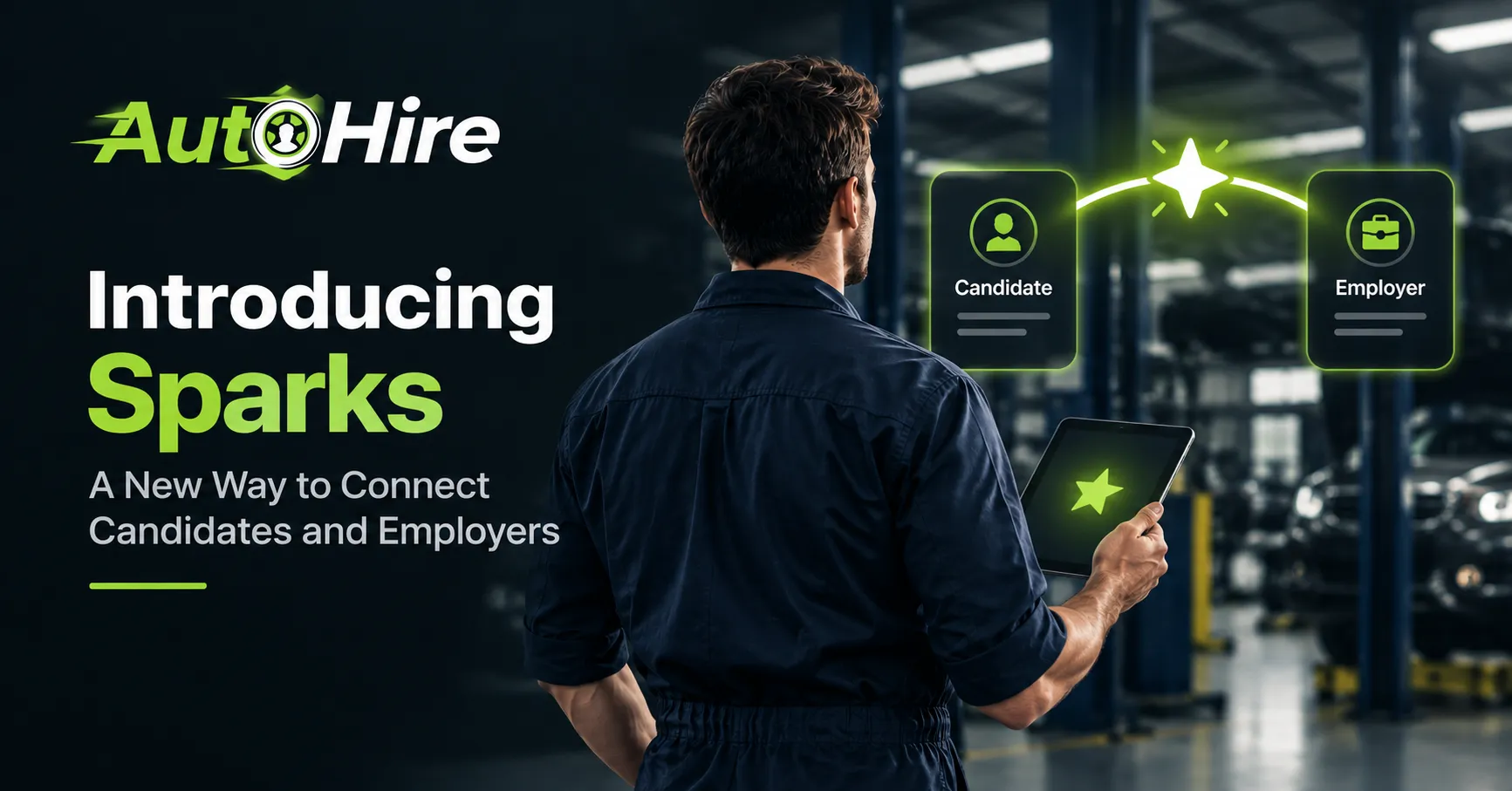
A Spark is the digital equivalent of catching someone's eye across the showroom floor. It's a lightweight interest signal — not an application, not a commitment, not even a conversation yet. It's a nod. A "hey, I see you, and I'm interested."
Candidates can Spark a job listing. Employers can Spark a candidate's profile. Both sides get notified, and from there, it's up to either party to take the next step — or not. No pressure, no obligation, no paper trail in your current dealer's HR system.
I've spent enough years in this business to know that the best hires rarely start with a formal application. They start with a conversation at an industry event, a referral from a parts vendor, a DM on social media. Sparks are designed to replicate that organic first-contact moment, but at scale and inside a platform built specifically for automotive.
The Candidate Experience: Low Risk, High Reward
Here's how it works on the candidate side. You're browsing listings on AutoHire — maybe you searched for "master technician" roles within 30 miles of your zip code. You see a posting from a Subaru dealer that looks interesting. Good pay range, solid benefits, and they mention a new facility opening next year. You're intrigued, but you're not ready to submit your full profile, upload a resume, and answer screening questions.
Instead, you hit the Spark button. You can attach a short note — 240 characters, think of it like a text message — something like: "15-yr Honda master tech, ASE L1 certified, interested in your EV expansion plans. Open to chatting."
The employer sees your name, your current role title, years of experience, general location, and that note. They don't see your full work history or your current employer's name unless you've made that public on your profile. From there, they can do one of three things: invite you to formally apply, send you a direct message to start a conversation, or simply file you away as a potential candidate for this or future openings.
Free accounts get 5 Sparks per month. That's enough to test the waters at a handful of stores without going overboard. Premium members get unlimited Sparks, which makes sense if you're actively exploring your options or you're in a hot market like the DFW metroplex where there might be 40 technician openings at any given time.
One thing I want to be clear about: a Spark is not an application. Your current employer won't get a notification. There's no "John Smith applied to XYZ Motors" moment. It's discreet by design, because I've watched too many good people get burned by premature visibility in a job search.
The Employer Side: Stop Waiting for the Perfect Application
Now flip it around. You're a service director at a three-rooftop group. You've had a senior tech opening for six weeks. You've gotten twelve applications — eight of them are lube techs with two years of experience applying for a role that needs someone with a diesel certification and seven-plus years. The other four either ghosted after you reached out or turned out to be 200 miles away and not willing to relocate.
Meanwhile, you've been browsing AutoHire's candidate pool and found three profiles that look like they could be exactly what you need. But reaching out cold with a formal interview request feels aggressive — these people aren't actively applying, and you don't want to come across like a desperate recruiter spamming LinkedIn.
Send a Spark instead. The candidate gets a notification that says your dealership group is interested in them for a specific role. They see your company name, the position title, and whatever note you include. Something like: "Saw your diesel certs and Cummins experience — we're expanding our commercial vehicle service dept and would love to talk."
I've seen this approach work incredibly well in the real world. When I was helping a dealer group in the Southeast fill a shop foreman role, the guy they ended up hiring wasn't looking. He was happily employed. But a well-timed, personalized outreach made him think, "Huh, maybe I should hear them out." That's what a Spark does — it opens a door without kicking it down.
Employers on any paid plan can send Sparks to candidates. You can track which Sparks have been viewed, which ones got responses, and which ones converted into applications. Over time, that data tells you a lot about your employer brand and how the market perceives your openings.
Why This Matters More in Automotive Than Anywhere Else
Here's the thing that generic job platforms like Indeed and ZipRecruiter will never understand about our industry: automotive hiring is relationship-first. Always has been, always will be.
A GM dealer in Ohio doesn't hire a finance manager the same way a tech startup hires a software engineer. There's no whiteboard interview. There's no take-home coding test. There's a gut check. Can this person hold gross? Do they know the compliance landscape? Will they fit the culture of a family-owned store that's been around since 1974?
Those questions don't get answered by reading a resume. They get answered through conversation, rapport, and mutual interest. Sparks create the conditions for that to happen naturally.
Think about the numbers for a second. The average dealership in the U.S. turns over roughly 40% of its staff annually — that's an NADA figure that hasn't budged much in years. That means a 50-person store is replacing 20 people every single year. If each of those hires starts with a slightly better first interaction — one where both sides have already signaled mutual interest — the quality of hire goes up and the time-to-fill goes down. We're already seeing early data on this: Spark-initiated conversations convert to hires at nearly 2x the rate of cold applications.
A Few Things Sparks Are Not
Let me head off some misconceptions before they start:
- Sparks are not a "like" button. This isn't social media. Every Spark is a real signal of professional interest, and both sides should treat it that way.
- Sparks don't replace applications. When you're ready to commit to a role, you still go through the full application process. Sparks are the handshake before the sit-down.
- Sparks are not visible to your current employer unless you've explicitly listed them as a reference or made your full profile public. Your privacy is protected.
Give It a Shot
Whether you're a technician wondering what's out there, a service manager building a bench of future hires, or a dealer principal trying to stay ahead of turnover, Sparks give you a new tool in the toolbox. It's the kind of feature that only makes sense on a platform built by people who actually understand how this industry works.
In my experience, the best career moves and the best hires both start the same way — with someone taking a small, low-risk step toward something that might be great. That's all a Spark is. Take one. See what happens.